Recently, a research article entitled “Media use and corruption perceptions: the mediating role of political trust and moderating role of group differences,” co-authored by Professor Zhijun Gu (corresponding author) and doctoral student Xiuxian Deng (first author) of the School of Government at Shenzhen University, was officially published online in the internationally renowned journal Humanities and Social Sciences Communications. The School of Government at Shenzhen University is the sole institutional affiliation listed in the publication.
Media are an important source of information through which the public understands and evaluates corruption. This study identifies media type and political trust as key explanatory factors underlying differences in corruption perceptions. Drawing on the Differential Susceptibility to Media Effects Model and data from the Chinese sample of Wave 7 of the World Values Survey, the study finds that traditional media use has no significant direct association with corruption perceptions, but can indirectly reduce perceptions of corruption by increasing political trust. Digital media use, by contrast, is directly associated with higher corruption perceptions and is further linked to greater perceptions of corruption through lower levels of political trust. Heterogeneity analysis reveals that the effects of digital media differ across gender and educational groups. The study emphasizes that different types of media may shape the public’s political perceptions through distinct psychological mechanisms. It provides new empirical evidence for understanding the relationships among media use, political trust, and corruption perceptions in the digital media environment.
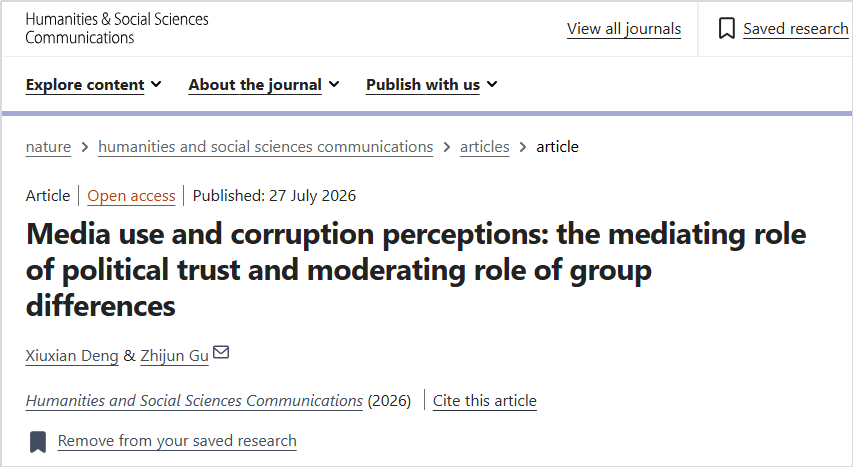
Humanities and Social Sciences Communications is a multidisciplinary humanities and social sciences journal published by Nature Portfolio. It is dedicated to publishing high-quality research in the humanities, behavioral sciences, and social sciences, and is indexed in both the Social Sciences Citation Index (SSCI) and the Arts & Humanities Citation Index (A&HCI). The journal is ranked in Quartile 1 (Q1) of the Journal Citation Reports (JCR). According to Clarivate’s Journal Citation Reports, based on its 2025 journal citation metrics, it ranks first among 403 journals in the Humanities, Multidisciplinary category and second among 276 journals in the Social Sciences, Interdisciplinary category. It is one of the world’s influential multidisciplinary academic journals in the humanities and social sciences and enjoys substantial international academic standing.
Full-text article: https://www.nature.com/articles/s41599-026-08487-z
Layout:Wu Yuxin
First Review:Deng Xiuxian
Second Review:Wang Yingying
Final Review:Gu Zhijun