Guangming Daily:
Chinese Social Sciences Net:
Nanfang Plus:
Event Highlights
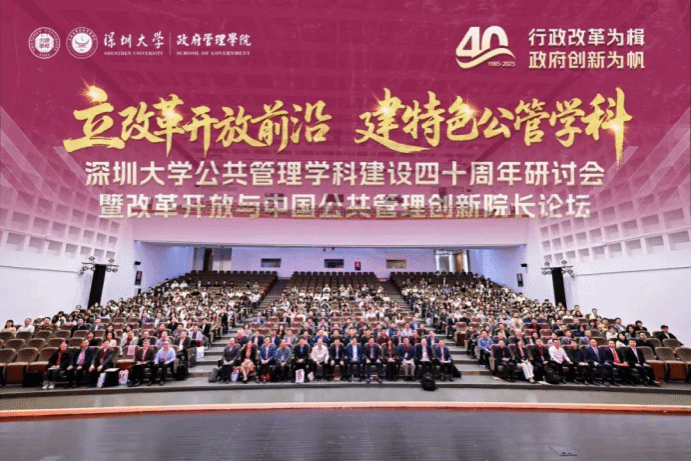
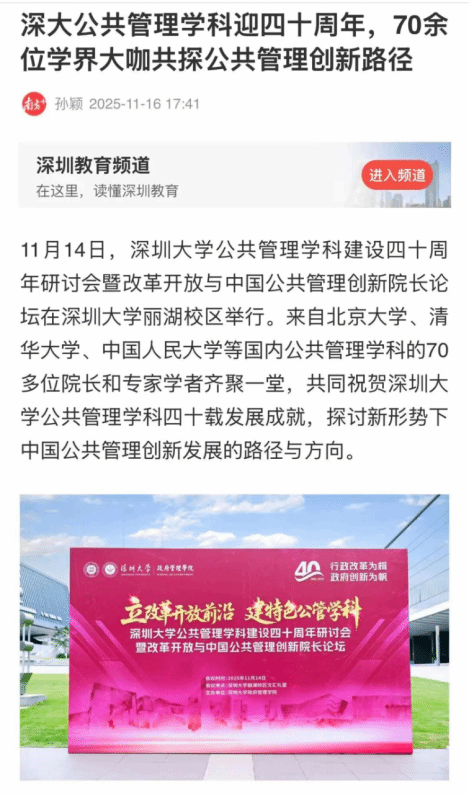
Over four decades of enduring hardships and forging ahead with perseverance. On November 14, 2025, the Seminar on the 40th Anniversary of the Development of Public Administration Discipline at Shenzhen University, themed "At the Forefront of Reform and Opening-up, Building a Distinctive Public Administration Discipline," and the Deans' Forum on Reform and Opening-up and Innovation in Chinese Public Administration were grandly held at the Lihu Campus of Shenzhen University. The event was hosted by the College of Government Management at Shenzhen University, bringing together more than 70 deans and expert scholars from public administration disciplines at institutions such as Peking University, Tsinghua University, and Renmin University of China. They gathered to celebrate the 40 years of achievements in the development of public administration at Shenzhen University and to discuss pathways and directions for innovative development in Chinese public administration under new circumstances. Professor Wang Yongcheng, Vice President of Shenzhen University, attended the opening ceremony and delivered a speech, with all faculty and students from the college in attendance.
The public administration discipline at Shenzhen University, with "administrative reform as the oar and government innovation as the sail," resonates in sync with the development of the special economic zone and advances alongside China's reform and opening-up. In 1985, the Department of Social Sciences Foundation at Shenzhen University was established, initiating preparations for the Department of Administration. In 1986, Shenzhen University officially launched the administrative management major class and began enrollment that year, becoming one of the earliest pioneers in China to establish an administrative management major. In 1987, the Department of Administration was officially established, making Shenzhen University one of the earliest comprehensive universities in China to set up a department of administration following the restoration and reconstruction of the discipline nationwide. In the same year, the Department of Administration at Shenzhen University edited the Series of Textbooks for Administrative Management Major, pioneering domestic discipline construction in administrative management and generating significant response nationwide.
Over four decades of dedicated academic pursuit, yielding abundant achievements. The discipline team has secured a total of 19 major and key projects from the National Social Science Fund, over 100 national-level research projects, published more than 300 papers in authoritative journals such as Social Sciences in China, Political Science Research, Sociological Studies, and Chinese Public Administration, and over 100 high-level English papers in international authoritative SSCI journals such as The American Review of Public Administration, Governance, Policy Sciences, Cities, and China Quarterly. Focusing on four key discipline directions—administrative management, public policy, urban-rural public governance, and social organization management—the team has published over 100 academic monographs, forming series of academic brands such as Frontiers in Public Administration Theory and Methods in the 21st Century, Research Series on Public Administration Reform and Innovation, Translation Series in Political Science and Public Administration; Empirical Research Series on Local Governance and Political Development in China, Research Series on Global Megacity Governance, Research Series on Innovative Practices in Chinese Urban Governance, Classic Translations in Foreign Urban Politics; Frontiers in Social Organization Management Theory and Methods; Contemporary Chinese Political Research Reports, Singapore Studies Series, and Hong Kong Issues Research Series. The discipline team has provided policy advice and served society, submitting a total of 256 research reports, of which 182 were adopted by central ministries and commissions, with an adoption rate as high as 71%. Many received affirmative instructions from central leaders, and multiple research outcomes have been integrated into national and local reform practices, providing intellectual support for Shenzhen's administrative system reform and innovation in Chinese local governments. At the same time, the discipline has built a complete talent cultivation system from undergraduate to master's and MPA levels, innovating the interdisciplinary PPS cultivation mode in political science, public administration, and sociology. Through deepened cooperation with world-renowned institutions, it has nurtured over 10,000 graduates who deeply engage in the Greater Bay Area and serve the nation, composing a talent cultivation chapter of "forging excellence and flourishing achievements."
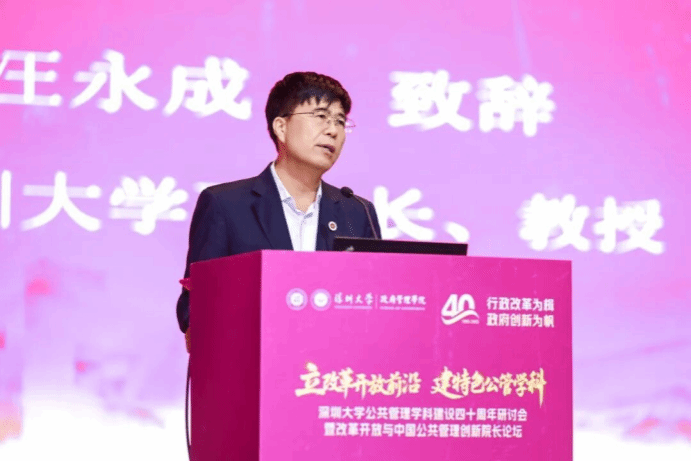
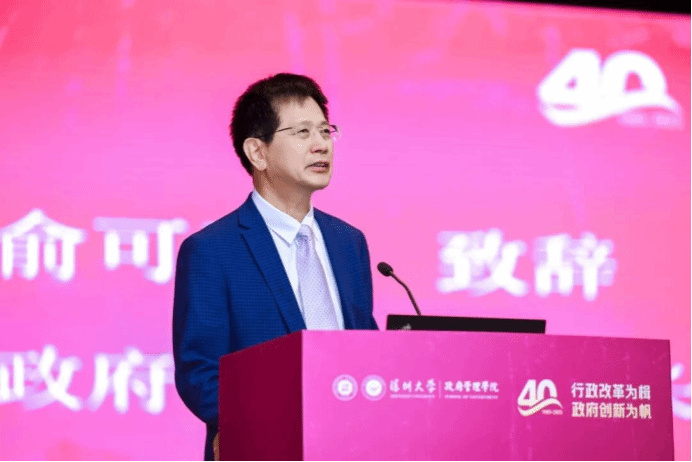
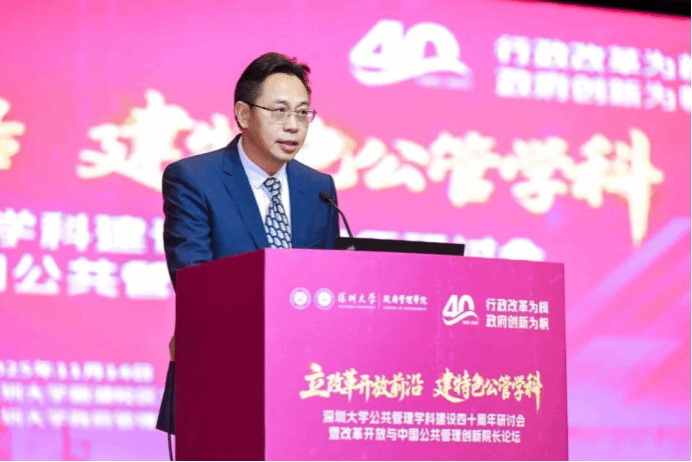
The opening ceremony of the seminar was hosted by He Yanhui, Party Secretary of the College of Government Management at Shenzhen University. In his speech, Vice President Wang Yongcheng reviewed the 40-year development journey of the public administration discipline growing alongside the special economic zone, wishing the discipline to take the 40th anniversary celebration as a new starting point for comprehensively advancing high-quality discipline development. Yu Keping, Dean of the College of Government Management at Shenzhen University and Chaired Professor at Peking University, centered on the theme "At the Forefront of Reform and Opening-up, Building a Distinctive Public Administration Discipline," introducing the basic concepts of discipline construction and future development plans, and expressing gratitude on behalf of the college to expert scholars and all sectors of society for their support.

As a representative of sister institutions, Ju Hua, Deputy Party Secretary and Professor of the School of Government at Peking University, extended warm congratulations on the 40th anniversary of the public administration discipline at Shenzhen University. She noted that from the very beginning of the establishment of the Shenzhen Special Economic Zone, Peking University actively participated in the preparation of Shenzhen University, with long-standing cooperation between the two institutions. The achievements of Shenzhen University's public administration discipline since preparing the Department of Administration in 1985 are evident to all: launching the administrative management major class in 1986 and editing the Series of Textbooks for Administrative Management Major in 1987. These pioneering efforts not only embodied the remarkable "Shenzhen speed" but also contributed to the development of administrative management discipline and talent cultivation nationwide. Over the past 40 years, the discipline has consistently aligned closely with major practical needs in national and local governance, forming distinctive features in fields such as administrative management, public policy, urban governance, and social organization management. Looking to the future, she expects the public administration discipline at Shenzhen University to seize the historical opportunities of the Pilot Demonstration Zone of Socialism with Chinese Characteristics and the Guangdong-Hong Kong-Macao Greater Bay Area to build discipline strengths, providing theoretical support for Chinese-style modernization governance; to integrate Chinese and foreign perspectives with a special zone and bay area vision, building an international academic exchange platform; and to rally efforts with a spirit of reform and innovation, cultivating more public administration talents with a global mindset. Finally, she sincerely wished the discipline enduring prosperity and new glories.

In his speech, Yan Jinming, Dean and Professor of the School of Public Administration at Renmin University of China, extended congratulations to all faculty, students, and alumni at home and abroad of the College of Government Management at Shenzhen University. He pointed out that Shenzhen is the "experimental field" and "pioneer" of reform and opening-up, and the public administration discipline at Shenzhen University was born alongside reform and opening-up, resonating with the development of the special economic zone and advancing with reform and opening-up. Rooted in Shenzhen and the Greater Bay Area, it responds to the practical needs of national governance modernization, producing a batch of high-quality research outcomes. As a window of reform and opening-up and a frontier of innovation, Shenzhen provides unique fertile ground and intellectual sources for the public administration discipline. The public administration discipline at Shenzhen University has achieved prominent results in serving local governance modernization, tracking and researching local government reform and innovation, and exploring new models for megacity development, forming distinct discipline characteristics and delivering a large number of high-quality public administration talents to the Guangdong-Hong Kong-Macao Greater Bay Area. Looking ahead, he hopes to continue the deep historical ties between Renmin University of China and Shenzhen University, advancing relevant cooperation based on the agreement signed between the two colleges, and calls on both sides and academic colleagues to jointly shoulder the mission of the new era: First, root in Chinese soil, base on the practice of Chinese-style modernization, summarize and refine a public administration theoretical system with Chinese characteristics and contemporary spirit, and build an independent knowledge system; second, respond to the questions of the times, closely focus on the needs of modernizing the national governance system and capacity, and provide high-quality solutions in key areas; third, adhere to openness and inclusiveness, strengthen international dialogue and exchange, and promote Chinese public administration discipline to the world through mutual learning of civilizations; fourth, devote wholeheartedly to moral education and talent cultivation, uphold the original aspiration of educating for the Party and the country, and nurture new talents of the era. He wished the discipline to take the 40-year celebration as a milestone and new starting point, carry forward the past and forge ahead, creating new glories.

Subsequently, Professor Chen Wen, Executive Dean of the College of Government Management at Shenzhen University, presented a report on the development of the public administration discipline. He reviewed the 40-year journey of discipline construction, systematically sorting out the main achievements in major construction, textbook compilation, scientific research, policy advice, talent cultivation, and international exchange. He focused on reporting the construction status of the four key discipline directions: administrative management, public policy, urban-rural public governance, and social organization management: The administrative management direction focuses on key areas such as modern government governance theory and methods, and administrative system reform, forming research characteristics in local government innovation, government governance capacity, clean government construction, major department system reform, special zone administrative system, and "one country, two systems" with Hong Kong and Macao administration; the public policy direction focuses on key areas such as public policy theory and methods, international public policy, and Chinese public policy practice and theoretical innovation, forming research characteristics in emerging industry policies, modern technology policies, Greater Bay Area and ASEAN cooperation policies, free trade zone policies, and special zone policy pilots; the urban-rural public governance direction focuses on areas such as urban public governance theory and methods, urban public governance, and integrated urban-rural development and governance, forming research characteristics in megacity governance, international metropolis governance, Greater Bay Area city cluster development, urban grassroots governance, and smart city construction; the social organization management direction focuses on areas such as social organization management theory and methods, and relations between social organizations and government, forming research characteristics in social organizations and social governance, social group management, public welfare and charitable organizations, disability social organizations, new social organizations, and barrier-free city construction.
The seminar featured three sessions: keynote speeches, roundtable meetings, and deans' forum.
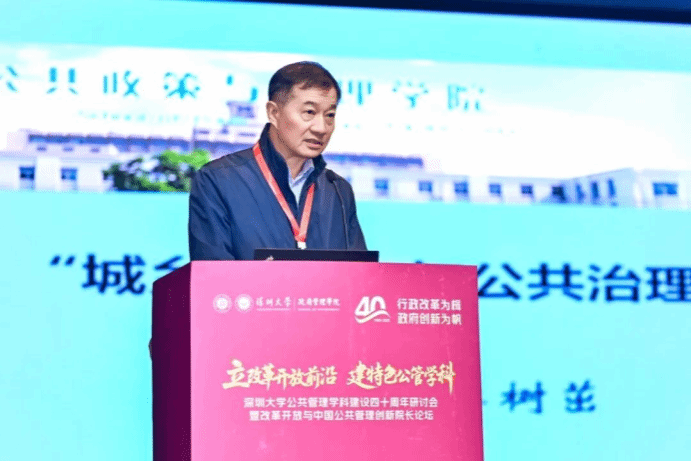
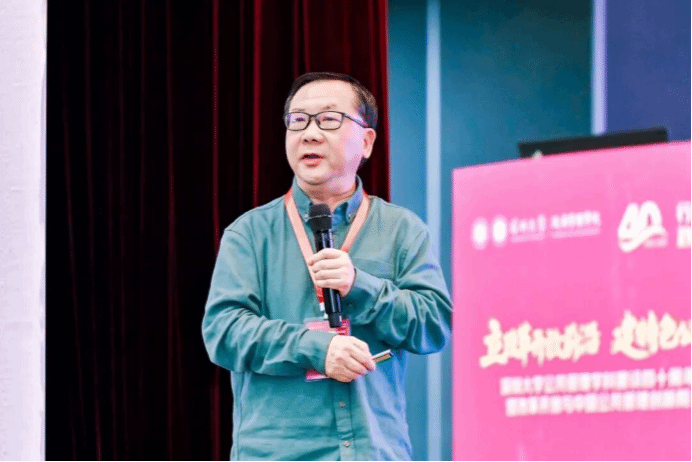
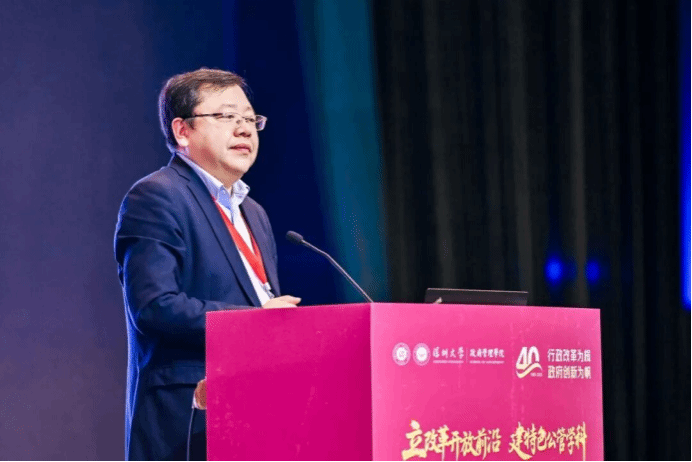
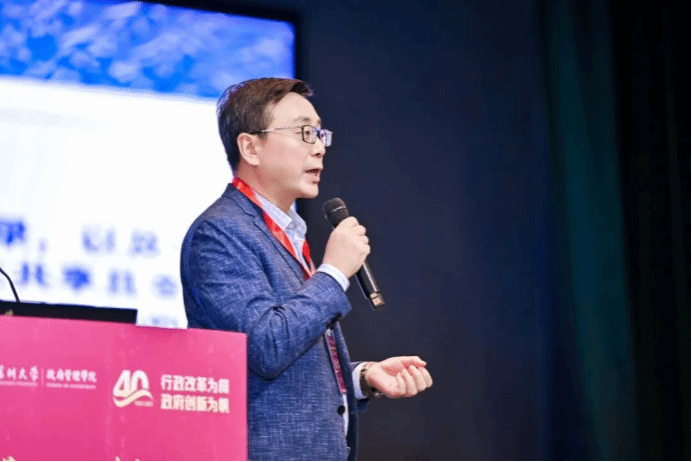
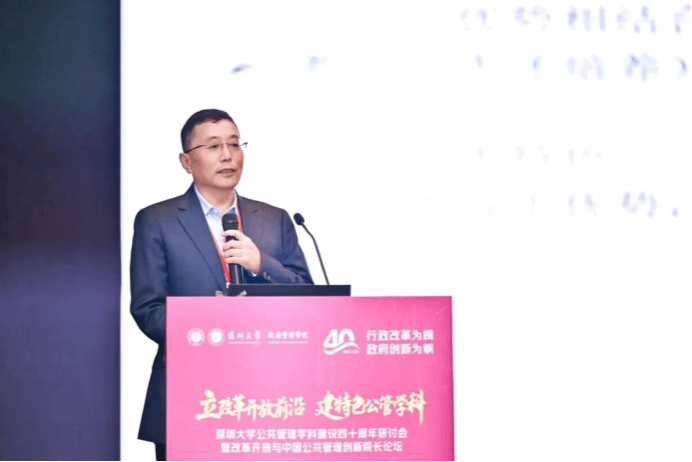
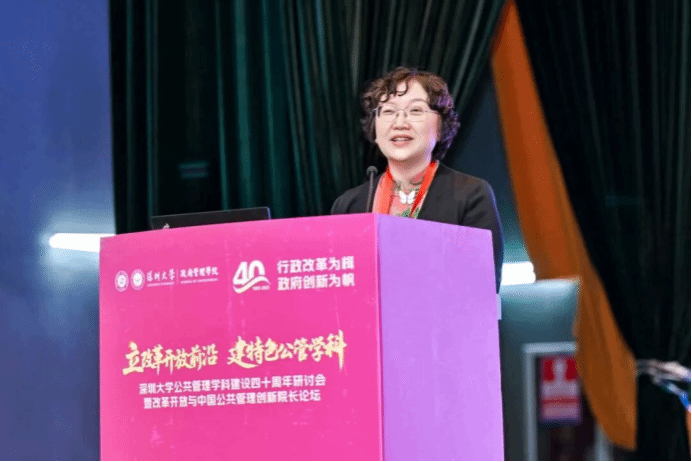
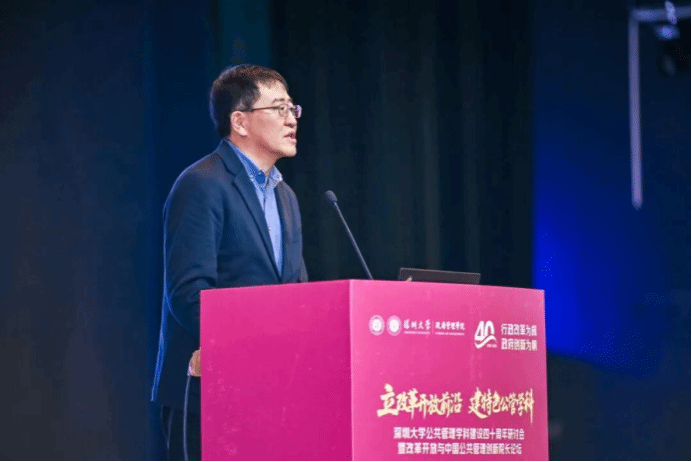
In the keynote speech session, Professor Li Shuzhuo from the School of Public Policy and Administration at Xi'an Jiaotong University, Professor Xiao Bin, Director of the Faculty of Social Sciences at Sun Yat-sen University, Professor Wu Jiannan, Dean of the School of International and Public Affairs at Shanghai Jiao Tong University, Professor Zhang Lei from the School of Humanities and Law at Northeastern University, Professor Ou Minghao from the College of Public Administration at Nanjing Agricultural University, Professor Jiang Xiaoping from the School of Public Administration at Sichuan University, and Professor Yan Jirong, Dean of the School of Government at Peking University delivered keynote speeches on reform and opening-up and innovation in Chinese public administration. They comprehensively discussed core topics such as frontier issues in public administration innovation, discipline development, and academic community construction, offering both theoretical interpretations and practical reflections, bringing valuable academic and practical insights to the audience.
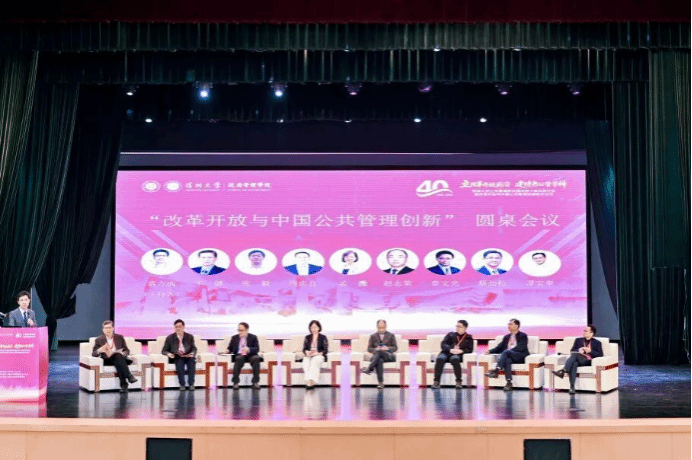
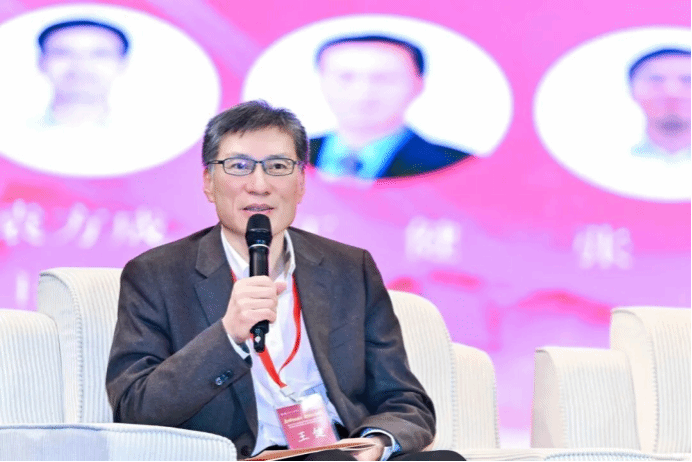
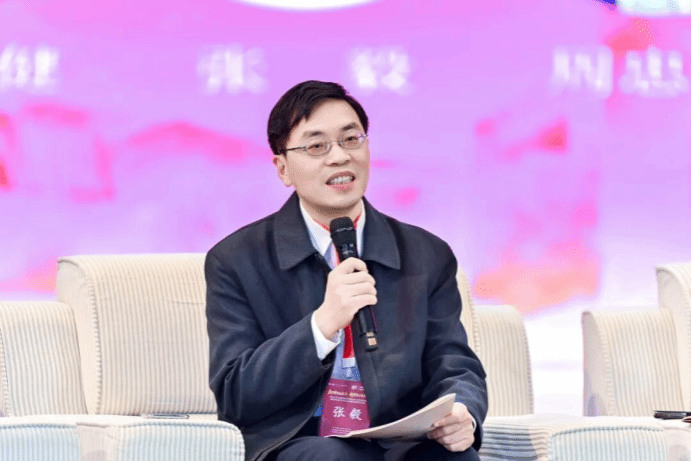
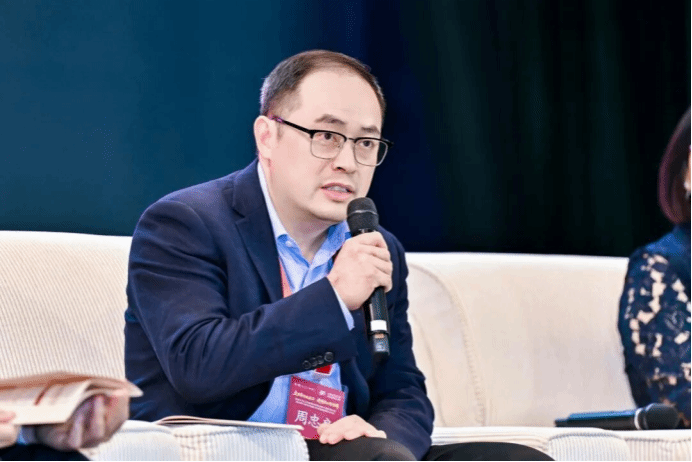
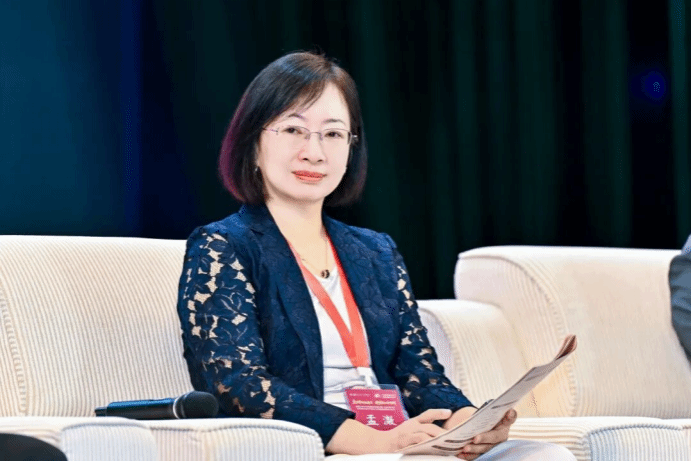
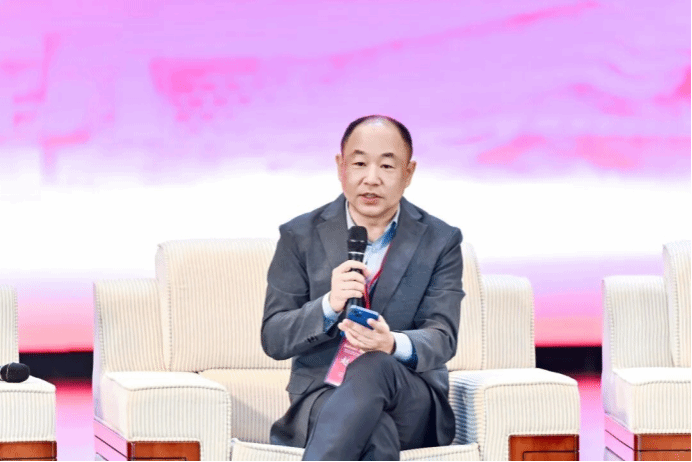
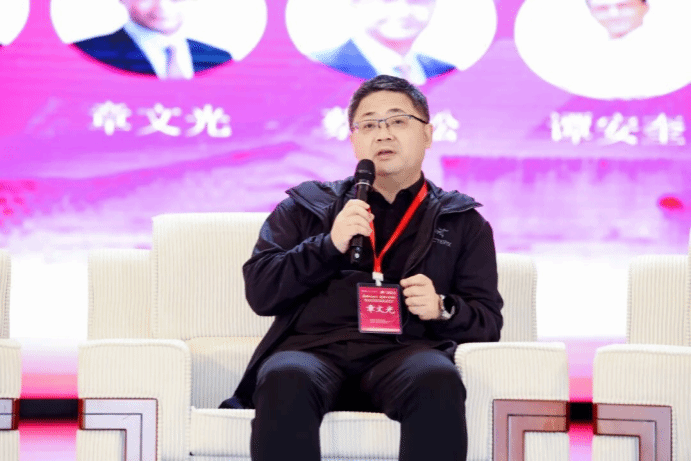
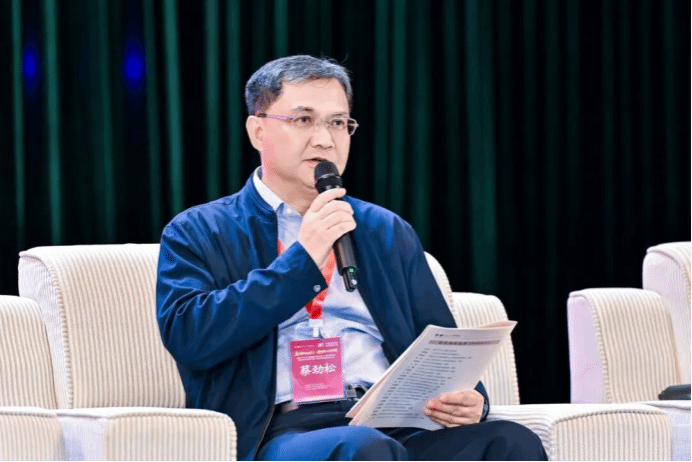
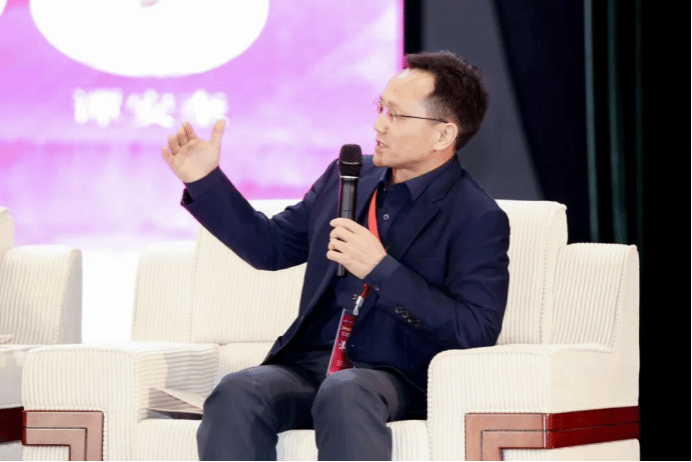
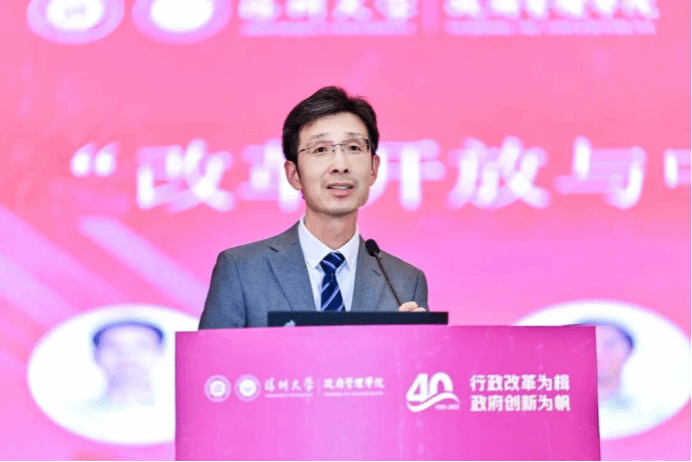
In the roundtable session, Professor Wang Jian, Dean of the School of Economics and Management at Harbin Institute of Technology, Professor Zhang Yi, Dean of the School of Public Administration at Huazhong University of Science and Technology, Professor Zhou Zhongliang, Dean of the School of Public Policy and Administration at Xi'an Jiaotong University, Professor Meng Wei, Dean of the School of Public Administration at East China Normal University, Professor Zhao Zhirong, Dean of the School of Public Administration at Zhejiang University, Professor Zhang Wenguang, Dean of the School of Government Management at Beijing Normal University, Professor Cai Jinsong, Dean of the School of Humanities and Social Sciences at Beihang University, Professor Tan Ankui, Dean of the School of Politics and Public Affairs Management at Sun Yat-sen University, and others discussed the theme "Reform and Opening-up and Innovation in Chinese Public Administration." Drawing on their institutions' discipline construction experiences and research fields, they delved into topics such as "reform and opening-up and government reform innovation," "characteristic development of public administration discipline in the digital intelligence era," and "practical paths for public administration innovation," engaging in in-depth discussions, idea exchanges, and viewpoint sharing.
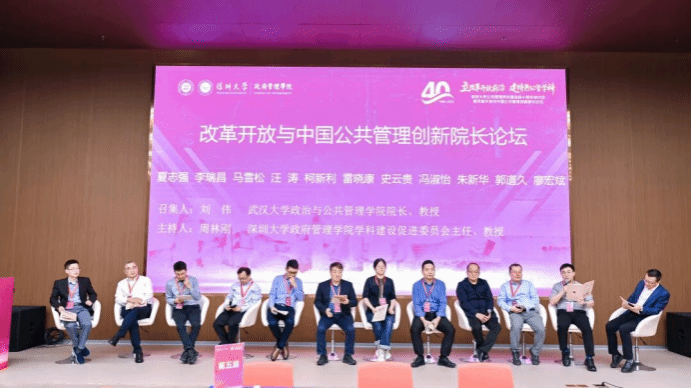
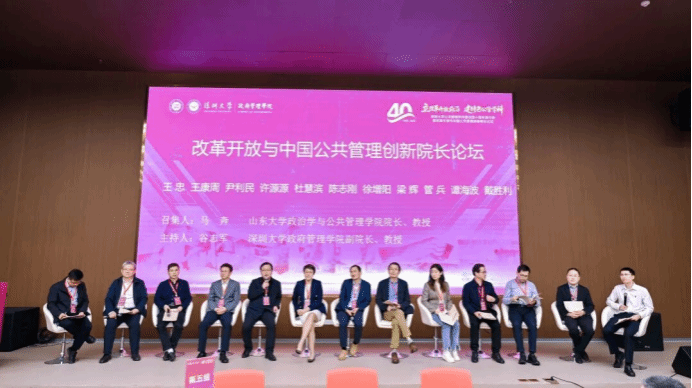
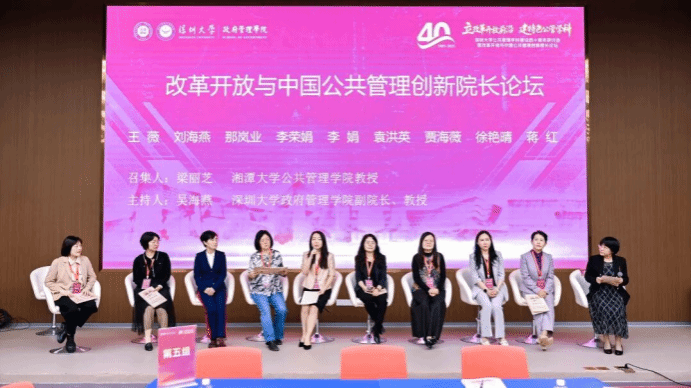
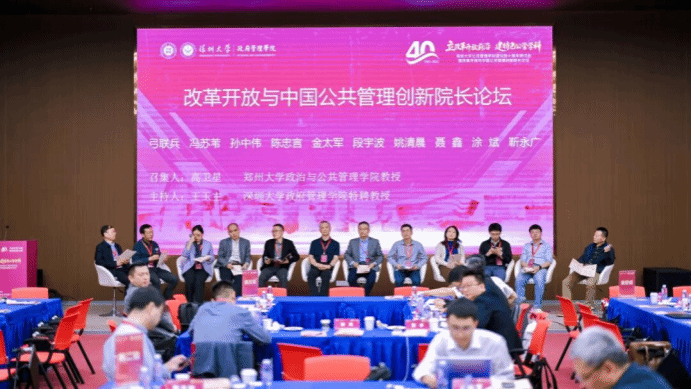
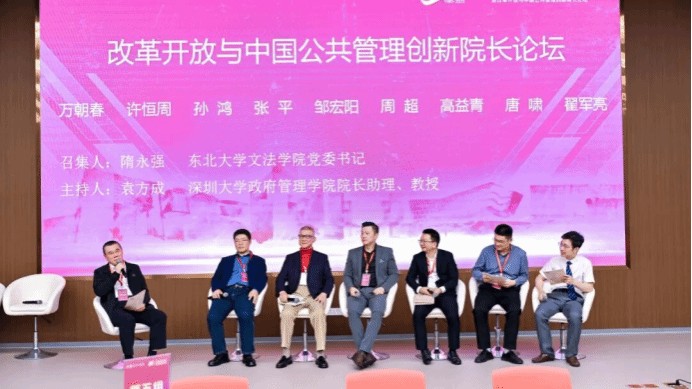
That afternoon, the 40th Anniversary Celebration of the Public Administration Discipline at Shenzhen University and the Deans' Forum on Reform and Opening-up and Innovation in Chinese Public Administration were held in Lecture Hall C101, Qiming Building, Lihu Campus. The first group convener was Professor Liu Wei, Dean of the School of Political Science and Public Administration at Wuhan University, hosted by Professor Zhou Lin'gang, Director of the Discipline Promotion Committee of the College of Government Management at Shenzhen University; participants included Professor Ma Xuesong, Dean of the School of Administration at Jilin University, Professor Shi Yungui, Executive Dean of the School of Public Administration at Zhejiang University of Finance and Economics, Professor Feng Shuyi, Dean of the College of Public Administration at Nanjing Agricultural University, Professor Zhu Xinhua, Dean of the School of Public Administration at Hohai University, Professor Sun Tao, Dean of the School of Humanities and Social Sciences at Harbin Institute of Technology (Shenzhen), Professor Li Ruichang from the School of International Relations and Public Affairs at Fudan University, Professor Wang Jinjun, Dean of the School of Public Administration at Zhejiang Gongshang University, Professor Ke Xinli, Dean of the School of Public Administration at Huazhong Agricultural University, Professor Hong Yanbi, Dean of the School of Humanities at Southeast University, Professor Xia Zhiqiang, Dean of the School of Public Administration at Sichuan University, Professor Lei Xiaokang, Dean of the School of Public Administration at Northwest University, Professor Liao Hongbin, Dean of the School of Public Administration at Southwestern University of Finance and Economics, Professor Guo Daojiu, Vice Dean of the Zhou Enlai School of Government at Nankai University, Professor Wang Tao, Vice Dean of the School of Public Administration at Chongqing University, and Li Yingming, Assistant to the Dean of the School of Public Policy and Management at University of Chinese Academy of Sciences, among others; the second group convener was Professor Ma Ben, Dean of the School of Political Science and Public Administration at Shandong University, hosted by Professor Gu Zhijun, Vice Dean of the College of Government Management at Shenzhen University; participants included Professor Wang Kangzhou, Dean of the School of Management at Lanzhou University, Professor Yin Limin, Dean of the School of Public Policy and Management at Nanchang University, Professor Xu Yuanyuan, Dean of the School of Public Administration at Central South University, Professor Du Huibin, Director of the Department of Management and Economics at Tianjin University, Professor Xu Zengyang, Dean of the School of Public Administration at Central China Normal University, Professor Tan Haibo, Dean of the School of Public Administration at Hunan University, Professor Dai Shengli, Dean of the School of Public Administration (School of Emergency Management) at Jinan University, Professor Guan Bing, Vice Dean of the School of Public Administration at South China University of Technology, Professor Wang Zhong, Vice Dean of the School of Public Administration at China University of Geosciences, Professor Chen Zhigang, Assistant to the Dean of the School of Government at Nanjing University, Associate Professor Liang Hui from the School of Public Administration at Zhongnan University of Economics and Law, among others; the third group convener was Professor Liang Lizhi, Dean of the School of Public Administration at Xiangtan University, hosted by Professor Wu Haiyan, Vice Dean of the College of Government Management at Shenzhen University; participants included Professor Wang Wei, Dean of the School of Public Administration and Law at Hunan Agricultural University, Professor Li Rongjuan, Dean of the School of Public Administration at Hubei University, Professor Yuan Hongying, Dean of the School of Government Management at Heilongjiang University, Professor Jiang Hong, Dean of the School of Government Management at Yunnan University, Professor Xu Yanqing, Executive Dean of the School of International Tourism and Public Administration at Hainan University, Associate Professor Liu Haiyan, Vice Dean of the School of Public Administration at Shanxi University of Finance and Economics, Professor Na Lanye, Vice Dean of the School of Public Administration at Inner Mongolia University, Professor Jia Haiwei, Vice Dean of the School of Public Administration at South China Agricultural University, Professor Li Juan, Director of the MPA Center at Shanxi University of Finance and Economics, Professor Liao Linyan from the School of Government Management at Yunnan University, among others; the fourth group convener was Professor Gao Weixing from the School of Political Science and Public Administration at Zhengzhou University, hosted by Distinguished Professor Wang Yuzhu of the College of Government Management at Shenzhen University; participants included Professor Nie Xin, Dean of the School of Public Administration at Guangxi University, Professor Tu Bin, Dean of the School of Society and Public Administration at Guangdong University of Foreign Studies, Professor Jin Taijun from the Law School at Anhui Normal University, Professor Gong Lianbing, Vice Dean of the School of International Affairs and Public Administration at Ocean University of China, Professor Feng Suwei, Vice Dean of the School of Public Administration at Shanghai University of Finance and Economics, Professor Sun Zhongwei, Vice Dean of the School of Politics and Public Administration at South China Normal University, Professor Duan Yubo, Vice Dean of the School of Public Administration at Shanxi University of Finance and Economics, Associate Professor Chen Zhongyan from the School of Government Management at Yunnan University, Associate Professor Yao Qingchen from the College of Humanities and Development at China Agricultural University, Associate Professor Jin Yongguang from the School of Public Administration at Shanxi University of Finance and Economics, among others; the fifth group convener was Sui Yongqiang, Party Secretary of the School of Humanities and Law at Northeastern University, hosted by Professor Yuan Fangcheng, Assistant to the Dean and Deputy Director of the Discipline Promotion Committee of the College of Government Management at Shenzhen University; participants included Professor Yu Wenxuan, Dean of the School of Public Affairs at Xiamen University, Professor Zhou Chao, Dean of the School of Politics and Public Administration at Guangxi Normal University, Wan Chaochun, Deputy Party Secretary of the School of Public Administration at Guangzhou University, Professor Xu Hengzhou from the Department of Management and Economics at Tianjin University, Visiting Professor Sun Hong from the Business Research Institute at University of Chester, UK, Professor Zhang Ping from the School of Humanities and Law at Northeastern University, Associate Professor Zou Hongyang from the Department of Management and Economics at Tianjin University, Associate Professor Gao Yiqing from the School of Society at Sanya University, Associate Professor Tang Xiao, Deputy Party Secretary of the School of Public Management at Tsinghua University, Associate Professor Zhai Junliang from the School of Public Administration at China University of Mining and Technology, among others. The attending experts highly affirmed the construction achievements of the public administration discipline at Shenzhen University over the past 40 years, considering it to have deep accumulation, abundant results, and distinct characteristics; forming discipline features in areas such as administrative system reform, science and technology industry policy, megacity governance, and social organization management. The deans' forum focused on public administration innovation practices and future discipline development, conducting in-depth discussions on the theme of reform and opening-up and innovation in Chinese public administration through five thematic groups, promoting exchange and cooperation among the colleges.

At the closing ceremony, Professor Chen Wen, Executive Dean of the College of Government Management at Shenzhen University, delivered a thank-you speech, particularly thanking the attending expert scholars for their strong support, and looking forward to frequent exchanges and joint cooperation with sister institutions to collectively advance the development of the public administration discipline. In the new era, the college is rooted in Shenzhen, embedded in the Greater Bay Area, and oriented toward the world, upholding the motto "Erudite and Skilled in Governance," focusing on the four key discipline directions of administrative management, public policy, urban-rural public governance, and social organization management. With united efforts and carrying forward the legacy, it will devote the full strength of the college to building the public administration discipline well.
Layout | Zeng Mengni
Copy | Liu Weirui, Wang Fuxiang, Zeng Mengni
First Review | Luo Wenting
Second Review | Wu Haowen
Final Review | Gu Zhijun