On the afternoon of June 12, 2026, the "Comparative Politics and National Governance Lecture Series" of Political Science at Shenzhen University was held in Room B201 of the Shouzheng Building at the Lihu Campus. Hosted by the School of Government of Shenzhen University and co-organized by the School of Humanities, the event invited Professor Bidyut Chakrabarty — former Vice-Chancellor of Visva-Bharati University, founded by Rabindranath Tagore, and an internationally renowned political scientist and historian — to speak on "Central and Local Governance in India." Professor Chakrabarty has taught for more than thirty years, enjoys an eminent reputation in Gandhian studies and South Asian governance, and has published 76 scholarly monographs. Associate Professor Yuan Chao of the Department of Political Science moderated the lecture and delivered the welcome address.
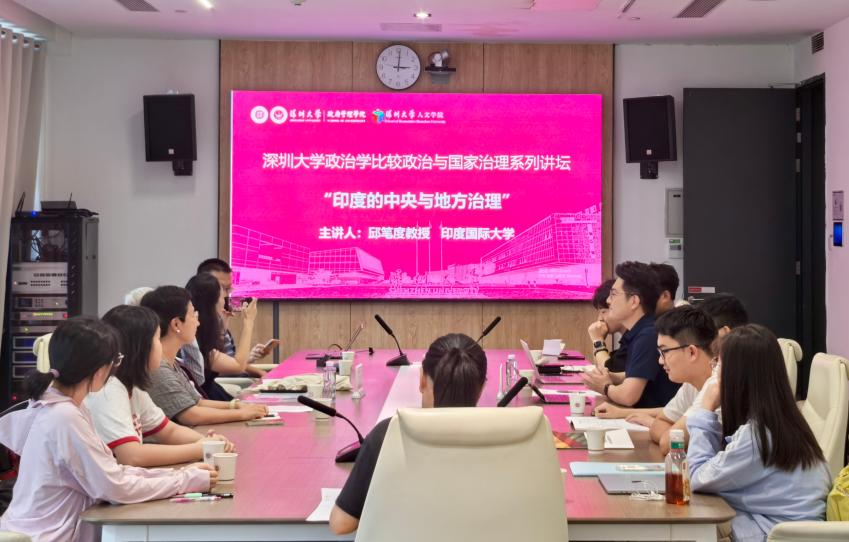
At the outset, using the five letters of STATE — Stability, Togetherness, Alignment, Thoughtfulness, and Empowerment — Professor Chakrabarty systematically expounded the nature and functions of the state, and then reviewed the Western theoretical genealogy of the state: from Aristotle's theory of capacities and structure, through the social contract theories of Hobbes and Rousseau, to the Marxist theory of class rule, Pareto's theory of elite oligarchy, and Foucault's theory of plural discourses. His central argument was that the Indian state cannot be subsumed under any single theoretical framework — much as a dish is prepared from a blend of many ingredients.
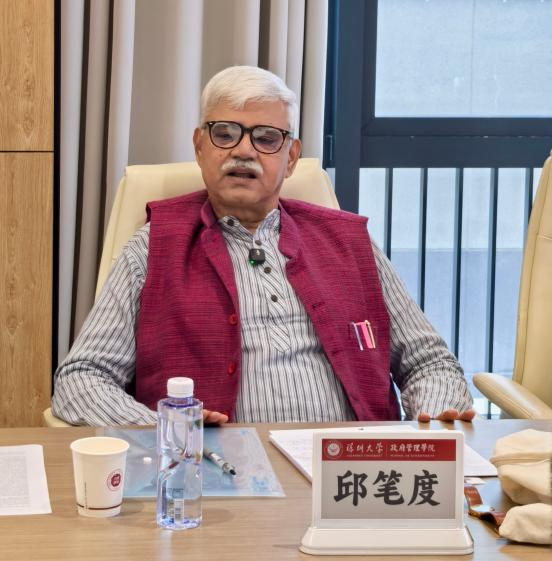
In the section on local governance, drawing on Gramsci's concept of "political society" and Marx's writings on the Paris Commune, he wove together Tanzania's Ujamaa movement and "Gram Swaraj" (village self-rule), which Gandhi proposed under the inspiration of the Buddhist sangha, before turning to the 73rd Constitutional Amendment of 1992: under which villages gained autonomy in 29 domains such as irrigation, education, and land use; no less than one-third of the seats in local governance institutions were reserved for women; and the Supreme Court's "basic structure" doctrine provides judicial safeguards for these provisions. He also frankly acknowledged that the gap between policy commitments and implementation, corruption, and the increasing politicization of local governance continue to pose significant challenges.
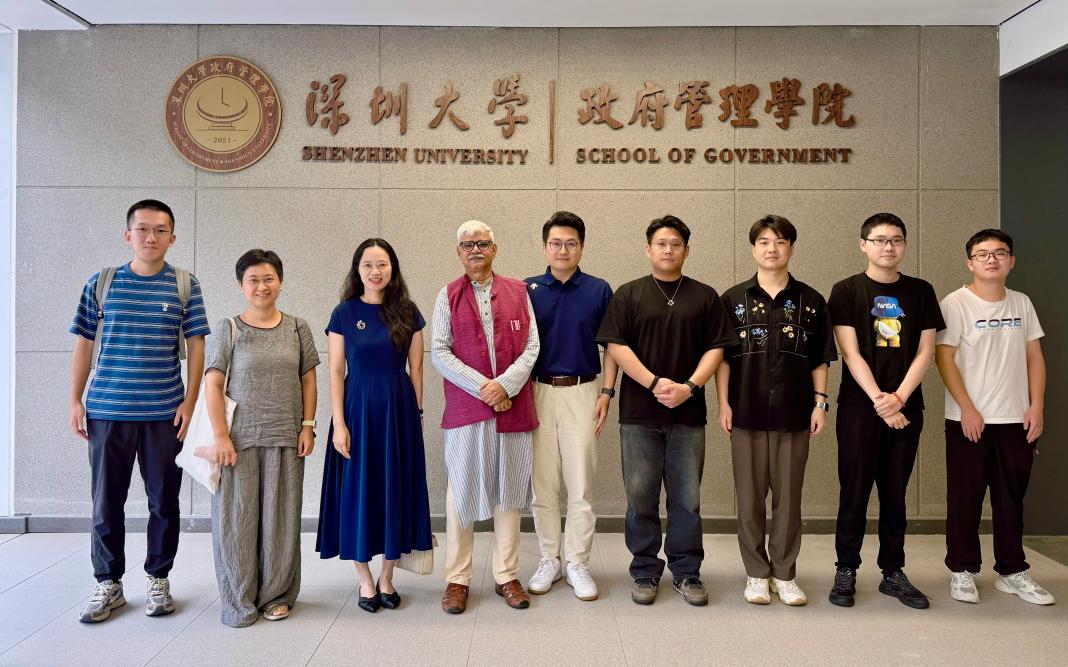
During the interactive session, Associate Professor Yuan Chao remarked that the lecture, moving from the nature of the state to the particularity of India, brilliantly fused the intellectual-history approach and the conceptual approach in political science. The students present also engaged in in-depth exchanges with Professor Chakrabarty on related themes. Combining theoretical depth with grounded in reality, the lecture offered faculty and students a rare opportunity to understand the relationship between state and locality from a cross-civilizational perspective.
Written by: Dong Zhenguang
Layout: Huang Yonglun
First Review: Zeng Yang
Second Review: Yuan Chao
Final Review: Gu Zhijun