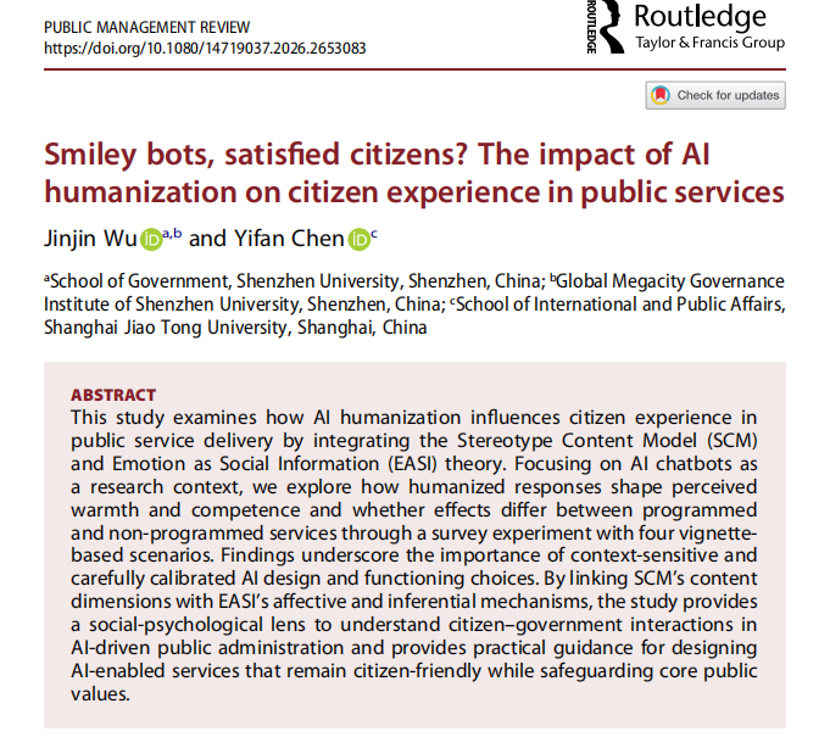
Recently, the paper “Smiley bots, satisfied citizens? The impact of AI humanization on citizen experience in public services,” with Associate Professor Wu Jinjin from our School as first author, was published online in Public Management Review, a leading international journal in public administration. Shenzhen University is the first affiliation. As the flagship journal of the International Research Society for Public Management, it ranks in JCR Q1, holds ABS/AJG 4-rated status, and is among the five most influential journals in the field of public administration.
By integrating the Stereotype Content Model (SCM) and the Emotions as Social Information (EASI) theory, the study investigates the impact of AI chatbot humanization on citizen experience in public services. Survey experiments conducted among citizens in six major Chinese cities show that AI humanization significantly increases perceived warmth; however, its positive effects weaken in complex, non-routine services such as policy consultation. The effect of humanization on perceived competence is context-dependent: it shows no significant impact in simple routine services (e.g., information inquiry) but generates negative effects in non-routine services, possibly because emotional expressions are perceived as less professional. The study concludes that the effects of AI humanization are neither universally beneficial nor harmful but are highly contingent on the type of public service. Practical implications suggest that government agencies should adopt differentiated AI interaction designs: actively incorporating humanization in routine services to enhance approachability, while emphasizing information accuracy and transparency in non-routine services and using emotional expressions cautiously, thereby striking a balance between improved user experience and maintained professional credibility.
Author Profile:
Wu Jinjin is Associate Professor, Deputy Director of the Department of Public Policy, Distinguished Researcher, and Doctoral Supervisor at the School of Government, Shenzhen University. He also serves as Deputy Dean of the Institute of Philanthropy at Shenzhen University and Deputy Director of the Disability Research Center at Shenzhen University. He has been selected into Shenzhen’s “Pengcheng Peacock Plan” and the expert pool of the Digital Guangdong Construction Expert Committee. His research focuses on cutting-edge topics such as digital governance and algorithmic decision-making. In recent years, he has published over 50 papers in top and authoritative domestic and international journals in political science, public administration, and sociology, including Public Management Review, The American Review of Public Administration, Contemporary Politics, The China Review, Sociological Studies, Political Science Research, Chinese Public Administration, Public Administration Review, Chinese Journal of Population Science, and Comparative Economic and Social Systems. Many of these papers have been reprinted in Xinhua Digest, Replicated Journals of Renmin University of China, and Social Sciences Digest. He serves as an anonymous reviewer for journals such as Political Science Research, Chinese Public Administration, Public Administration Review, and Public Management and Policy Review, and as a young editorial board member for several others, including Journal of the Party School of Ningbo Municipal Committee of the CPC, Journal of Guizhou University of Finance and Economics, and Digital Governance Review.
Article Source:
https://doi.org/10.1080/14719037.2026.2653083
Layout | Liu Weirui
First Review | Wang Yingying
Second Review | Wu Jinjin
Final Review | Gu Zhijun