Recently, the paper “Governance and the mismatch between perceived and spatial healthcare access: Evidence from ten Chinese mega-cities,” co-authored by Assistant Professor Guo Jing and Professor Liu Xiao from the Department of Public Policy at our School, together with Dr. Cai Wensi from Glasgow Caledonian University, was published in the internationally prestigious journal Cities. Assistant Professor Guo Jing serves as the first author, Professor Liu Xiao as the corresponding author, and Shenzhen University as the first affiliation.
Accessibility to urban healthcare services depends not only on spatial proximity but also on residents’ subjective perceptions of institutional responsiveness and fairness. Integrating perspectives from uncertain geographical contexts, spatial mismatch theory, and governance studies, this research examines the “perceived-spatial” mismatch in healthcare accessibility across ten Chinese megacities. The study combines 10,290 individual survey responses regarding perceived accessibility, governance quality, and digital literacy with a national hospital travel time dataset at the kilometer-grid level. Multi-level regression analysis reveals that, after controlling for spatial and demographic factors, governance quality—measured by responsiveness, transparency, fairness, and trust—continues to significantly enhance residents’ positive perceptions of healthcare accessibility. Governance plays a moderating role between space and perception: in areas with stronger governance performance, the negative effect of distance on perceived accessibility is notably reduced. Digital literacy amplifies the positive effects of governance, whereas institutional barriers based on household registration weaken them. Cities with stronger governance capacity exhibit smaller mismatches between perceived and objective accessibility.
These findings demonstrate that effective governance can partially offset spatial inequalities and strengthen residents’ sense of equitable access to healthcare, underscoring that “soft infrastructure” centered on trust and responsiveness is equally vital.
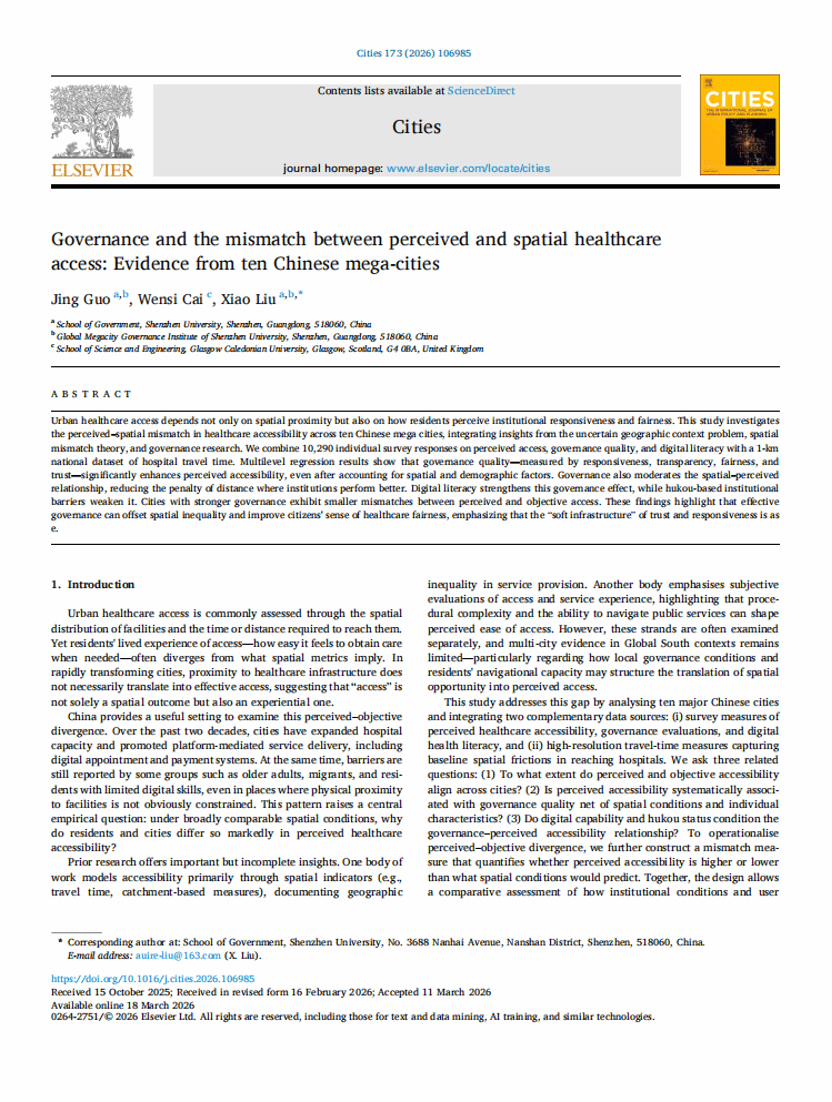
Published by Elsevier, Cities is an internationally authoritative journal in urban studies, dedicated to publishing high-quality research on urban policy, planning, governance, and development. Indexed in the SSCI database, the journal has a latest impact factor of 6.6 and ranks in JCR Q1 in the Urban Studies category.
Author Profile:
Guo Jing, Assistant Professor, Department of Public Policy, School of Government, Shenzhen University
Cai Wensi, PhD Candidate, Glasgow Caledonian University
Liu Xiao, Professor, Department of Public Policy, School of Government, Shenzhen University
Article Source: https://www.sciencedirect.com/science/article/pii/S0264275126002179
Layout | Liu Weirui
First Review | Wang Yingying
Second Review | Guo Jing
Final Review | Gu Zhijun