Research Direction of "Urban Politics and Urban Governance" in Political Science
"Urban politics and urban governance" are a key area and distinctive direction of discipline development at the School of Government of Shenzhen University, supported by the Institute of Global Megacity Governance and the Research Center for Innovative City Development and Governance. The research team has long focused on urban political phenomena and urban governance issues, tracked new theories and new methods of urban politics at home and abroad, and explored theoretical questions of great practical significance and practical questions of great theoretical significance in the field, striving to foster an academic community of research on urban politics and urban governance and to develop theories in this field with Chinese characteristics and a global vision.
Recently, a research paper solely authored by Wu Jianxian, a postdoctoral fellow of the School of Government, entitled "Does centralisation clean up? quasi-experimental evidence from China's environmental reforms" was published online in the leading institutional economics journal Journal of Institutional Economics, with Shenzhen University as the sole affiliation.
The study examines whether the centralization of environmental regulatory power can improve air quality by addressing the governance failures inherent in decentralized arrangements. Using the phased implementation of China's centralized environmental regulation reform as quasi-experimental evidence, the study finds that regulatory centralization significantly reduced particulate matter concentrations through three mechanisms: first, by insulating decision-making from local relational networks and corrupt practices, thereby effectively reducing elite capture; second, by correcting data manipulation caused by distorted incentives, an effect reflected in the convergence of satellite monitoring data with officially reported data; and third, by internalizing cross-jurisdictional negative externalities through matching regulatory scope with the boundaries of pollution diffusion. Heterogeneity analysis shows that the emission-reduction effects are concentrated in regions with heavier pollution and deeper corruption, while differences in economic development level and industrial structure have relatively limited effects. These findings deepen theoretical understanding in institutional economics and provide causal-inference evidence that governance structure reforms targeting elite capture and principal–agent problems can deliver significant environmental improvements, offering implications for the design of regulatory institutions in developing economies with weak local institutional capacity.
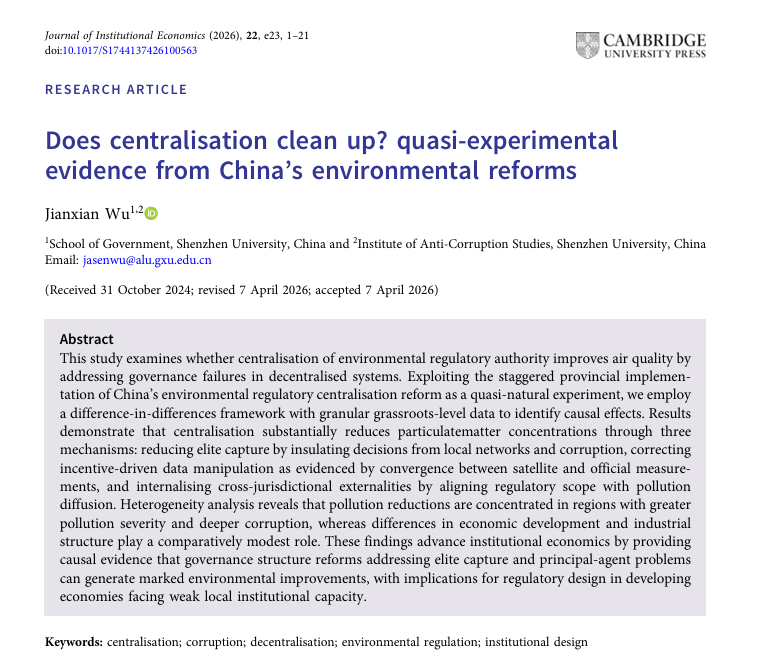
Journal of Institutional Economics is published by Cambridge University Press and was founded by Professor Geoffrey M. Hodgson, a contemporary heir of the old institutional economics and a Fellow of the British Academy. The journal is indexed in the Social Sciences Citation Index (SSCI) database, with an impact factor of 2.5, ranking in the Q1 quartile of the JCR.
Article source: https://doi.org/10.1017/S1744137426100563
Layout: He Gengyi
First Review: Wang Yingying
Second Review: Wu Jianxian
Final Review: Gu Zhijun