Research Direction of "Urban Politics and Urban Governance" in Political Science
"Urban politics and urban governance" is a key area and distinctive direction of discipline development at the School of Government of Shenzhen University, supported by the Institute of Global Megacity Governance and the Research Center for Innovative City Development and Governance. The research team has long focused on urban political phenomena and urban governance issues, tracked new theories and new methods of urban politics at home and abroad, and explored theoretical questions of great practical significance and practical questions of great theoretical significance in the field, striving to foster an academic community of research on urban politics and urban governance and to develop theories in this field with Chinese characteristics and a global vision.
Recently, a research paper completed by Professor Gu Zhijun of the Department of Political Science of the School of Government as corresponding author, in collaboration with Ms. Ma Wenting of Harbin Institute of Technology, Shenzhen (first author) and Luo Xinyi, a master's student in the Department of Political Science, entitled "From Viral to Vital: The Impact of City Branding Strategies on Internet-Famous Cities" was published online in the leading international journal Cities.
Against the backdrop of rapid urbanization and increasingly fierce inter-city competition, many small and medium-sized cities face difficulties such as population outflow and sluggish economic growth. Some cities have tried to build themselves into "internet-famous cities" through digital platforms, hoping to leverage online traffic to boost local tourism and economic vitality. How, then, can these cities make the transition from "going viral" to "staying vital"? What roles do government intervention and public participation play in this process? Existing research has yet to provide systematic answers to these questions. In response, the study proposes a three-tiered framework of city branding strategies: general city branding strategies (tourism policies and city labels), internet-famous-city-specific strategies (official media publicity and timely government responsiveness), and higher-order strategies (public participation), and employs a mixed method combining descriptive statistics and Qualitative Comparative Analysis (QCA) to systematically analyze 28 internet-famous cities in China.
The study finds: The rapid rise of China's internet-famous cities is characterized by marked volatility and high mobility. In the viral breakthrough stage, public participation and unexpected online events played a key role; in the stage of sustaining long-term popularity, the government's tourism policies, official publicity, and governance responsiveness became crucial. The study further reveals how different combinations of city branding strategies affect urban attractiveness, economic growth, and industrial structural transformation, underscoring the importance of synergy between government governance capacity and grassroots online dynamics.
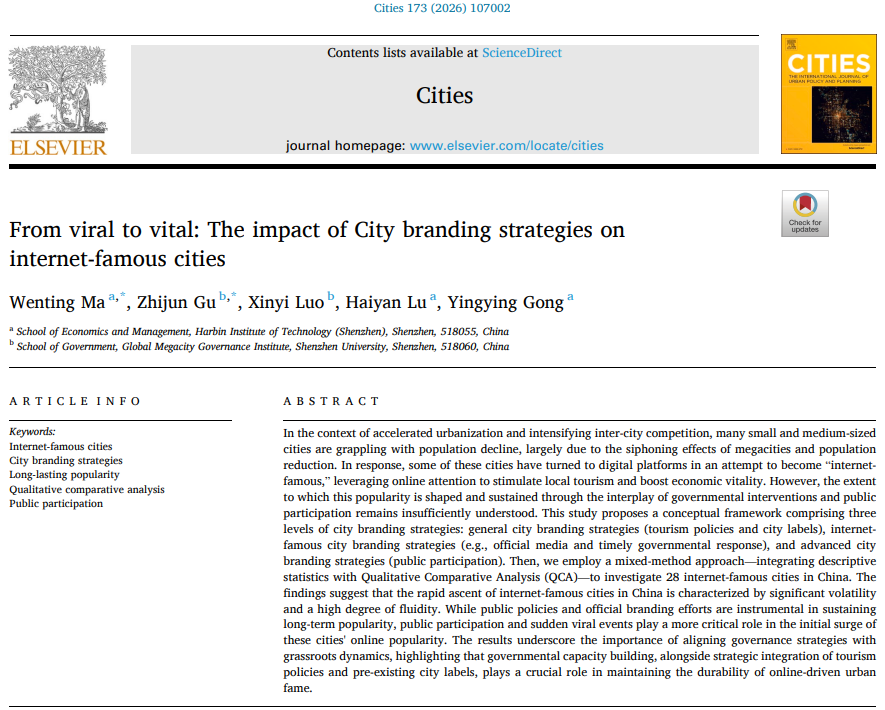
Cities is published by Elsevier and is a leading international journal in urban studies, dedicated to publishing high-quality research on urban policy, planning, governance, and development. The journal is indexed in the SSCI database, with a latest impact factor of 6.6, ranking in the JCR Q1 quartile in the "Urban Studies" category.
Author Profile:
Gu Zhijun is Vice Dean, Professor, and doctoral supervisor at the School of Government of Shenzhen University and the Institute of Global Megacity Governance.
Article source:
https://www.sciencedirect.com/science/article/pii/S0264275126002349
Layout: He Gengyi
First Review: Wang Yingying
Second Review: Luo Wenting
Final Review: Gu Zhijun