To deepen interdisciplinary talent cultivation under the new liberal arts framework and promote the deep integration of classroom teaching with governance practice, the Government Management Innovation Class (PPS) at Shenzhen University recently organized the “Practical Research Series” activities. Led by Professor Chen Wen, Executive Dean of the School, students visited the Shenzhen ShenHong New Economy Comprehensive Development Research Institute for research and exchanges, and observed the on-site presentation and review meeting for the 2025 “Top Ten Rule of Law Events in Shenzhen.” Through these real-world governance scenarios, they witnessed the vibrant practice of Shenzhen’s government governance innovation and rule of law construction.
The Government Management Innovation Class is an interdisciplinary undergraduate joint cultivation innovation project established in response to the Ministry of Education’s undergraduate education reform and Shenzhen University’s “New Liberal Arts” initiative. Led by the School of Government, it integrates public administration, political science, and sociology, aiming to cultivate composite talents with solid theoretical foundation, strong practical ability, and a deep sense of public service.
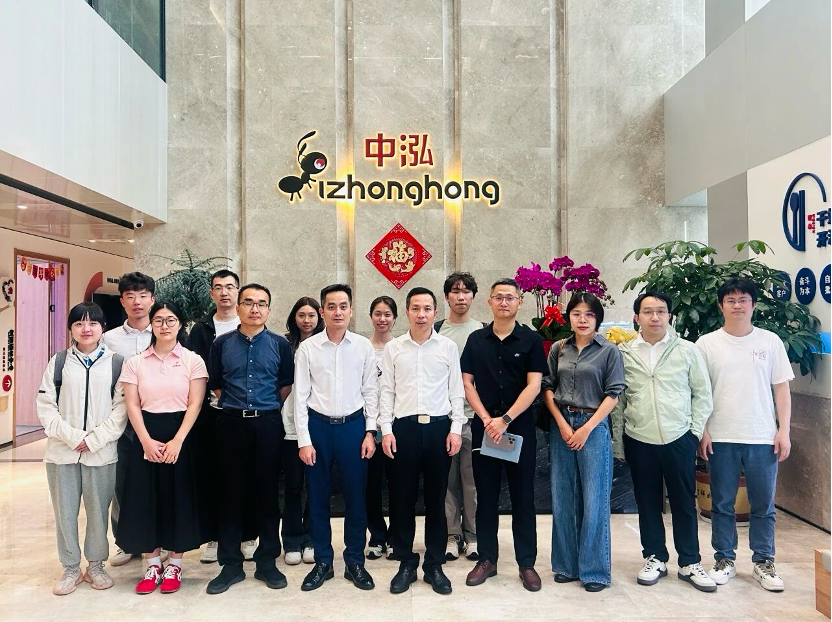
On March 24, Professor Chen Wen led a group of PPS students to the Shenzhen ShenHong New Economy Comprehensive Development Research Institute for field research. Through on-site visits and discussions, the students gained deeper insights into the construction of urban intelligent governance platforms and developed a more intuitive understanding of how digital technologies empower urban governance and how university-enterprise collaboration advances practical education.
On March 26, all PPS students attended as observers the on-site presentation and review meeting for the 2025 “Top Ten Rule of Law Events in Shenzhen.” Professor Chen Wen was invited to serve as an expert reviewer and successfully secured valuable on-site learning opportunities for the students. Representatives from over 50 organizations across the city presented innovative achievements in rule of law construction, covering areas such as arbitration mechanism innovation, precise enterprise-related law enforcement, reform of real estate enforcement models, business environment supervision, cross-departmental collaborative governance, and digital grassroots governance.

During the session, students actively reflected on the presentations in light of their academic learning and gained deeper appreciation for Shenzhen’s rule of law practices.
Case: “Shenzhen Court of International Arbitration Handles the Nation’s First Arbitration Case Involving False Statements in Stocks”
Student Lin Qianting shared her reflections: resolving such emerging disputes through arbitration represents an innovative exploration in rule of law practice. She noted that arbitration offers high procedural efficiency, relatively low costs, and flexible application scenarios. In a dynamic city like Shenzhen with active market players and intensive commercial activities, it provides richer institutional options for investor protection and dispute resolution, demonstrating precise alignment between rule of law supply and urban development needs.
Student Wang Yutian remarked that the observation gave her a more concrete understanding of the concept of “arbitration venue.” She observed that arbitration is favored by many market entities because it combines legal authority with commercial efficiency. The rising credibility and influence of arbitration in Shenzhen reflect the continuous optimization of the city’s rule-of-law-based business environment.
Case: “Guangming District Justice Bureau Advances More Precise and Standardized Enterprise-Related Law Enforcement through the ‘Five-One’ Work System”
Student Kong Xinshu highlighted the institutional value of the “one enterprise, one file” system and source-level compliance building. She believes this approach shifts regulation from broad, post-event handling to targeted and precise governance, helping reduce enterprise burdens while enhancing law enforcement effectiveness.
From the perspective of the business environment, student Zhang Zirou noted that institutional designs such as enterprise profiling, reduced on-site inspections, and closed-loop supervision address enterprises’ practical concerns about overlapping and repetitive checks. These measures promote more standardized enforcement and better services, transforming the rule of law into a development safeguard that stabilizes expectations and boosts confidence.
Case: “Nanshan District Court Innovatively Implements the ‘Self-Disposal’ Model for Real Estate Enforcement by the Enforced Party”
Student Yu Enxi focused on the integration of judicial wisdom and market logic. She observed that this mechanism, through designs such as “sealed transfer,” ensures creditor rights while minimizing property value depreciation. It overcomes the traditional dilemma of balancing efficiency and value protection, reflecting a holistic judicial approach to effectiveness, efficiency, and fairness.
Case: “The ‘One-Stop’ Mechanism of the Business Environment Complaint and Supervision Center at Longgang District People’s Procuratorate”
Student Xiao Hongyi emphasized that its significance lies not only in efficiently addressing enterprise complaints but also in using platform-based and collaborative approaches to closely link mediation, arbitration, and litigation, thereby facilitating interconnected dispute prevention, problem diversion, and closed-loop resolution. This multi-departmental, digitally empowered governance model illustrates the new trend of grassroots rule of law construction becoming increasingly refined and systematic.
Case: “Dapeng New Area Innovatively Establishes a Cross-Departmental Comprehensive Supervision Mechanism for Homestays”
Student Zhou Pei was deeply impressed by the tiered classification and off-peak supervision approaches. She noted that the ABC grading system and “721” supervision method enable more scientific allocation of regulatory resources, reducing burdens on operators while improving the precision and effectiveness of supervision. In particular, the off-peak supervision arrangements during low and peak seasons embody the modern governance principle of “non-interference when all is well and precise policy application.”
Case: “Futian Public Security Branch Innovatively Implements the ‘Convenient Enterprise WeChat’ Platform”
Student Zhou Jiayu reflected from the perspective of digital grassroots governance. He believes that establishing a “24-hour online law enforcement team” via the Enterprise WeChat platform not only accelerates responses to public demands but also shortens the distance between public security organs, enterprises, and citizens, making grassroots governance more perceptible, accessible, and participatory. This technology-driven governance innovation enhances efficiency while conveying the warmth of the rule of law.
The “Practical Research Series” serves as a key initiative by the Government Management Innovation Class to advance practical education and strengthen interdisciplinary cultivation. By visiting research institutions and observing rule of law review sessions, students gained a more authentic understanding of the practical logic behind government governance innovation and further strengthened their sense of responsibility and mission to serve society and participate in governance. Looking ahead, the Government Management Innovation Class will continue to leverage diverse practical platforms, align knowledge learning with real-world observation, and continuously improve the quality of cultivating innovative and composite public governance talents.
Layout | Liu Weirui
First Review | Li Zhaosheng
Second Review | Yuan Chao, Fu Yang
Final Review | Liu Xiao