On July 24, 2026, the international conference "Cities across Boundaries: Urban Governance and Discourse," co-hosted by the School of Government and the Institute of Global Megacity Governance of Shenzhen University together with the Institute of East Asian Studies and the Center for Chinese Studies of Dongseo University, Korea, was successfully held in Busan, Korea. The conference brought together experts and scholars from universities in China and Korea, who engaged in in-depth discussions on governance innovation, digital transformation, social equity, and cultural identity in the course of East Asian urbanization.
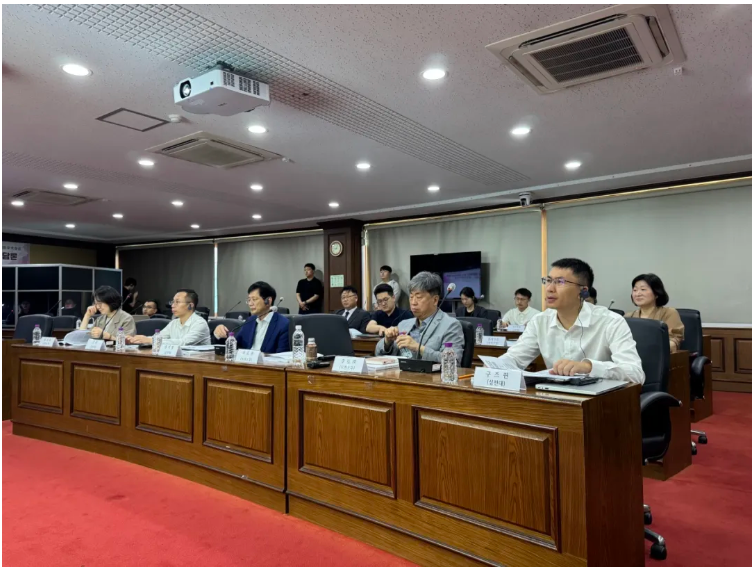
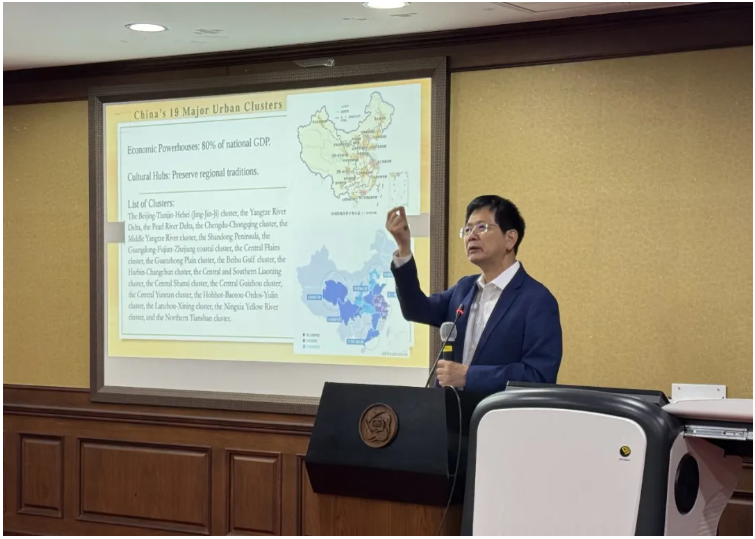
Professor Lee Hong-gyu, Director of the Center for Chinese Studies at Dongseo University, served as general moderator of the conference and wished it every success. Professor Shin Jung-seung, former Ambassador of the Republic of Korea to China and Dean of the Institute of East Asian Studies at Dongseo University, delivered welcome remarks. As a senior diplomat who took part in the 1992 negotiations on the establishment of China–ROK diplomatic relations and a key promoter of city exchanges between the two countries, he congratulated the conference on its successful opening and wished it fruitful outcomes. Professor Yu Keping, Chair Professor at Peking University and Dean of the School of Government at Shenzhen University, then gave a presentation entitled "Urbanization and Modernization in China since Reform and Opening-Up," systematically explicating the historical logic of their deep coupling. Focusing on China's 19 major city clusters — covering strategic units such as Beijing–Tianjin–Hebei, the Yangtze River Delta, the Guangdong–Hong Kong–Macao Greater Bay Area, and the Chengdu–Chongqing region — he noted that, as "economic engines," they concentrate about 80% of national GDP while also serving as "cultural hubs," sustaining regional traditions and identities amid rapid development. In his view, Chinese modernization has always been accompanied by urbanization, with megacities and city clusters driving development through powerful agglomeration effects; the quality of China's future modernization will be deeply bound up with the governance capacity of its megacities. This compound "economy–culture" analysis both strengthened the empirical foundation and revealed, from the dimensions of governance and discourse, the theoretical significance of city clusters as nodes of "cross-boundary connection," providing important Chinese experience and a frame of reference for the conference theme "Cities across Boundaries: Urban Governance and Discourse."
The conference featured four parallel panels on the following themes: governance innovation in megacities, subaltern discourse of gateway cities, urban history and narrative, and a student session.
Panel I: Governance Innovation in Megacities
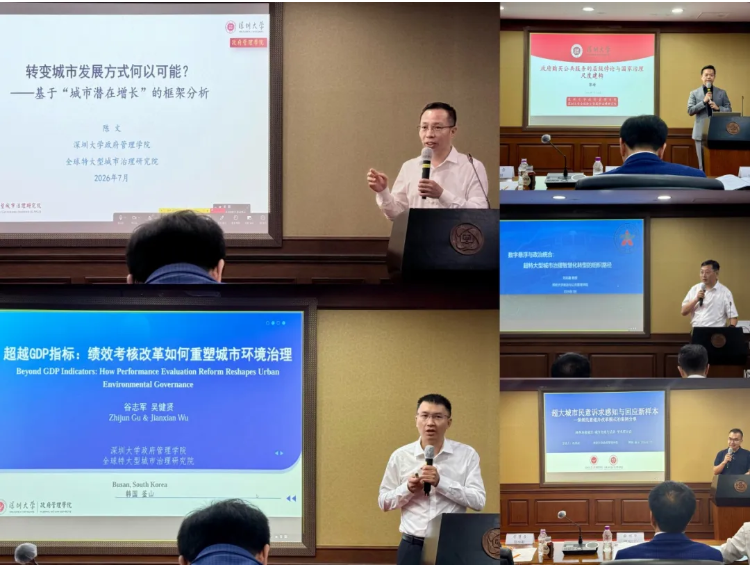
The panel was chaired by Professor Lee Hong-gyu, with commentary from Professor Kang Byung-hwan and Professor Jang Yun-mi of Dongseo University. Executive Dean Professor Chen Wen presented "How Is a Transformation of Urban Development Modes Possible? A Framework Analysis Based on Potential Urban Growth in China." He constructed a "3G" analytical framework of "dynamics–pathways–goals" and, at the critical juncture when China's urbanization rate is approaching 70%, systematically diagnosed the deep-seated contradictions facing urban development and explored pathways to sustainable transformation. Vice Dean Professor Gu Zhijun presented "Beyond GDP Metrics: How Performance Evaluation Reform Is Changing Urban Environmental Governance." Focusing on the major institutional shift of China's government performance evaluation from "GDP-oriented" to a "public-service-oriented" approach, he explored its impact on the effectiveness of urban environmental governance. Professor Liu Zhaoxin, Vice Dean of the School of Politics and Public Administration at Zhengzhou University, presented "Digital Suspension and Political Integration: Organizational Pathways of the Smart Transformation of Governance in Supersized Cities." He proposed the concept of "digital suspension," revealing that even when the digital platforms of megacities achieve data aggregation and process visualization, they may still lack substantive governance efficacy owing to insufficient organizational uptake. Assistant Professor Guo Jing presented "The Hierarchical Paradox in Government Purchase of Public Services and the Scalar Construction of State Governance," pointing out that in practice the lengthening of information chains turns superior resource advantages and grassroots demand information into a "hierarchical paradox," triggering supply–demand mismatches. Assistant Professor Feng Xiucheng, in "A New Sample of Perceiving and Responding to Public Appeals in the Social Governance of Megacities," focused on the modernization of urban governance and, taking Shenzhen's "Minyi Suban" (swift handling of public appeals) model as the research object, explored innovative practices in perceiving and responding to public appeals in megacities.
Panel II: Subaltern Discourse of Gateway Cities
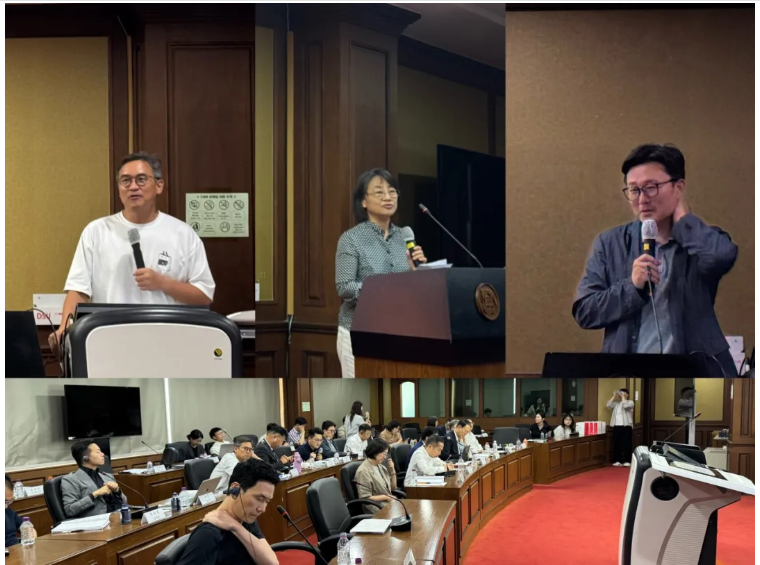
The panel was chaired by Professor Gu Zhijun, with commentary from Professor Yuko Nagasawa of Waseda University, Japan, and Associate Professor Yuan Chao. Professor Kim Dong-gyu of Pukyong National University, Korea, in "Reading the City from a Subaltern Perspective," critically examined the complicit relationship between modernity and urban planning, introducing the concept of "subaltern subjectivity" and analyzing Busan as a case. Professor Jeon Seong-hyeon of Dong-A University, Korea, presented "Democratization and Subalternity in the Gateway City of Busan," examining, from the perspective of subalternity, the distinctive character of the democratization movement in Busan and the historical existence of subaltern subjects. Professor Tang Juan presented "Uplifting Vulnerable Groups through the Third Distribution: The Case of Philanthropy in Shenzhen." She explored how the third distribution — the allocation of social resources and wealth by social forces, driven by voluntariness and moral commitment, through charitable donations, public-welfare funding, volunteer service, and other means — as a supplement to primary market distribution and government redistribution, can effectively support vulnerable groups through philanthropy.
Panel III: Urban History and Narrative
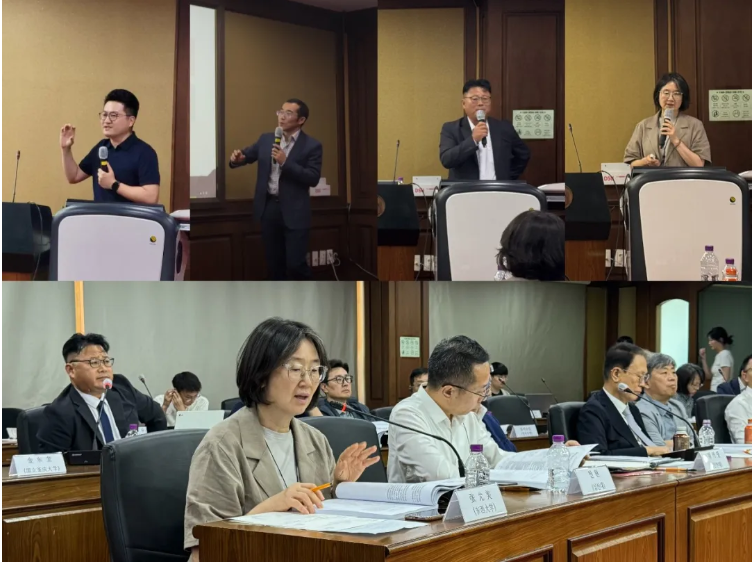
The panel was chaired by Professor Chen Wen, with commentary from Professor Kim Ji-yeong of Dongseo University and Professor Tang Juan. Associate Professor Yuan Chao presented "The 'Historical' and the 'Non-Historical': Narrative Reconstruction and Space Production in Small and Medium-Sized Inland Chinese Cities." He explored the central paradox of why inland cities endowed with genuine historical remains must nevertheless resort to large-scale "non-historical" faux-antique landscapes in order to "activate" historical value in the mass tourism market. Assistant Professor Li Yan of the School of Humanities and Social Sciences at the University of Science and Technology Beijing presented "Rupture and Repair: Comparative Narratives of Urban Regeneration in the Ancient City of Beijing." Constructing a three-tier progressive analytical framework of "space production–governance mechanisms–narrative discourse" and addressing the dual character of the hutongs in Beijing's old city — carriers of vernacular cultural memory and sites of governance challenges — he compared the "relocation-based redevelopment" of Jinbao Street with the "micro-regeneration" of Shijia Hutong, revealing that the key to success lies in whether "embedded institutional choices" can match communities' "endogenous institutional needs." Professor Jang Yun-mi, in "Urban Discourse and Spatial Repositioning in Shanghai," took Shanghai as a case to examine the features and implications of urban discourse and spatial reconfiguration in China in recent years, focusing on how the "state–family" discourse is concretized through public space display, education and publicity, and the fusion of governance mechanisms, and embedded in grassroots social practice. Professor Kang Byung-hwan presented "The Snail-House Movement and the Evolving Logic of Housing Discourse among East Asian Youth: The Case of Kaohsiung, Taiwan, China." He elucidated the structural "housing injustice" facing young people in East Asia against the deepening financialization and commodification of housing, and analyzed the discursive paradigm shifts and dynamic mechanisms of youth housing movements.
Panel IV: Student Session
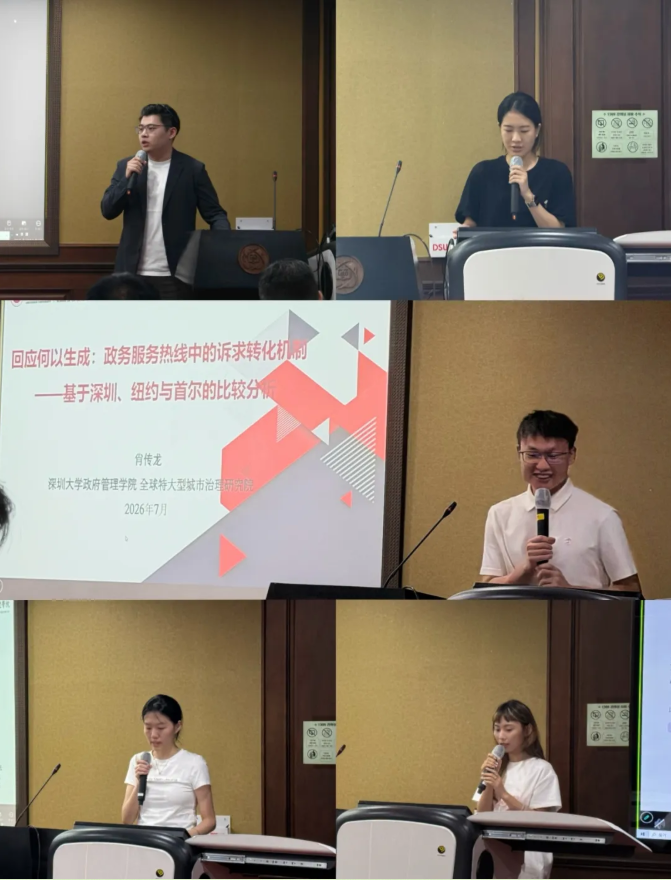
The panel was chaired by Dr. Yin Renlu of Dongseo University, with commentary from Dr. Fang Zixuan, Dr. Jin Rongqi, Dr. Yu Ruisheng, and Dr. Jin Duiyuan of Dongseo University. Doctoral candidate Xiao Chuanlong presented "How Are Responses Generated? The Mechanism of Converting Appeals in Government Service Hotlines." He defined the hotline as an organizational conversion hub linking social expression with the administrative system, and proposed an analytical framework of "authority activation–accountability coding–coordinated implementation." Doctoral candidate Wang Zuyao, in "How Is the 'Synergy Medium' of Cross-Institutional Collaboration Generated?" focused on the cross-institutional governance context of the Guangdong–Macao In-Depth Cooperation Zone in Hengqin, exploring how the normalized structural tensions arising from conflicts of legal-system compatibility, dilemmas of mixed-property regulation, and mismatches of governance cognition are transformed, through micro-mechanisms, into synergistic governance efficacy. Doctoral candidate Deng Xiuxian presented "Information Environment and Governance Judgments: Media Use Repertoires and Corruption Perceptions in the Chinese Context." Based on the Chinese sample of the seventh wave of the World Values Survey, she examined how the multi-source information environment shapes public perceptions of corruption and governance judgments through the diversity and structure of media use. Master's candidate Chen Liangzi, in "Career Development Predicaments of Newly Employed Urban Women in the Digital Economy and Governance Responses," focused on the multiple predicaments facing trainee livestreamers amid the rise of the platform economy — inadequate digital skills, weak professional identity, limited resource support, family caregiving pressures, and social evaluation biases — and explored the challenges these pose to urban public services and grassroots governance innovation. Master's candidate Liang Yujie, in "How Do Algorithms Drive the Building of Clean Cities? A Study of the 'Smart Discipline Inspection' System of the Customs in City S," built on the customs case of City S a framework of "empowerment–power containment–adaptation," analyzing how algorithms, through data integration, model building, and business closed loops, achieve the externalization of tacit knowledge, panoramic monitoring of the exercise of power, and the reengineering of organizational processes. Park Sung-min, a doctoral candidate at Dongseo University, presented "Ansan, Korea's Earliest Intercultural City." Taking Ansan — the first Korean city to be designated an "Intercultural City" — as the research object, he explored the concrete pathways and implications of practicing the ideal of interculturalism in urban governance and of moving foreign migrants and local residents from mere coexistence toward communication and integration. Cao Helin, a master's candidate at Dongseo University, presented "Yangsan, a Growing City, and Its Migrants." Adopting the position that migrants should be regarded as constitutive members of the local society rather than external others or mere recipients of aid, she examined how Yangsan, Korea, responds to migrants' settlement needs and promotes inclusive urban development through institutional building and diverse support practices.
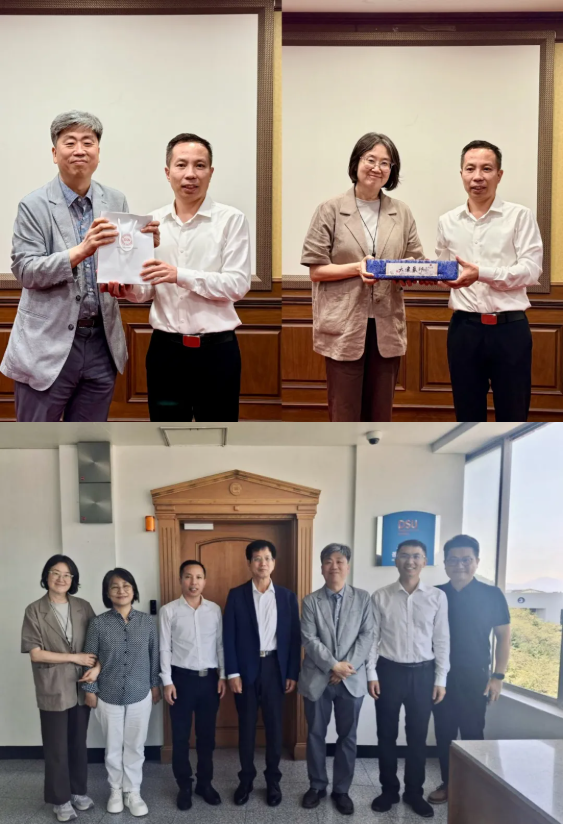
Through the clash of ideas between Chinese and Korean scholars, the international conference on East Asian urban studies, "Cities across Boundaries: Urban Governance and Discourse," not only deepened the understanding of China's urbanization process and the modernization of its governance, but also provided valuable comparative experience and policy references for other East Asian economies in urban transformation, migrant integration, and digital governance. Both sides stated that they would further strengthen exchanges and cooperation in related fields.
Layout: He Gengyi
First Review: Wang Zuyao
Second Review: Yuan Chao
Final Review: Gu Zhijun